
Restorative justice dialogue: Programs & practices
-
Restorative justice conferences bring together the person harmed, the person responsible, and sometimes community members. These gatherings allow everyone involved to discuss the harm, its impact, and ways to repair it through open, mutual understanding.
-
In cases where direct meetings are challenging, structured and shuttle dialogues provide a private setting to safely share perspectives. This can be in person or remote, allowing individuals to connect in a comfortable environment.
-
When direct interaction isn’t possible or preferred, a facilitator acts as an intermediary, relaying messages or written statements to foster communication safely and indirectly.
-
Acknowledging harm through a formal apology or written agreement can be meaningful, offering validation to the person harmed while promoting accountability.
-
For people not ready, or not able to have direct engagement through other restorative approaches, Solidarity and Support Circles can help people harmed to process experiences, build empathy, and understand the impact of actions on themselves on others.
Solidarity Circles are safe spaces for survivors and others impacted by harm. We develop this approaches for individuals (including in family and community settings) and also expect to open invitations to a closed group in early 2025.
Click here to register your interest or get in touch with Melissa melissa@transformingjustice.org.au
-
Engaging the person responsible in acts of service, treatment or reparation fosters positive contributions, repairing harm in a broader sense and reinforcing responsibility to the community. This may involve participating in community accountability or engaging in treatment or support services.
Click here to register your interest in our Community Accountability programs and opportunities for people responsible or at risk of causing harm, their families and community members.
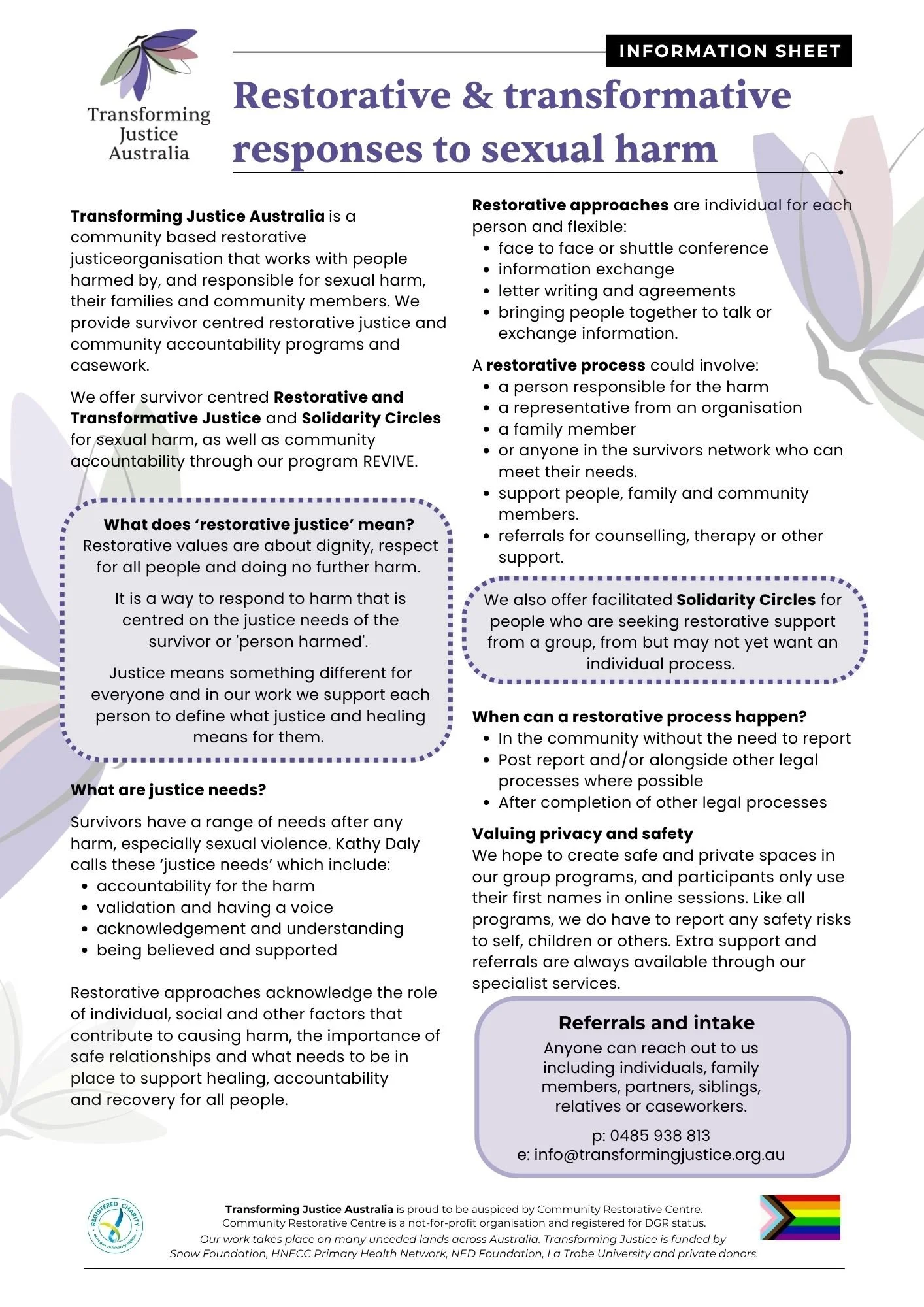
Questions and answers about facilitated restorative justice dialogue processes
Who can be part of a facilitated restorative justice process?
An individual facilitated restorative justice process can involve anyone who is important to the survivor.
This may include the person responsible for causing harm, as well as support people, family members, or others close to the survivor.
Sexual abuse affects survivors in many ways, including their relationships with family, friends, and their wider community.
Survivors should have access to support, things that support their healing and justice needs and be entitled to meaningful accountability.
Those invited to participate in restorative justice processes can play a variety of roles.
We also recognize that people close to the survivor may have said or done things that were unhelpful or even harmful. This is a common experience and sometimes survivors are seeking a safe space to have these conversations with family, friends, community members or representatives.
In our practice, we take a flexible, individualized approach to each case.
What kinds of facilitated restorative justice opportunities are possible?
We provide many restorative opportunities.
For some people, meeting in a conference or circle may be important; but other restorative opportunities might be more suitable such as exchanging information or seeking a written apology from the person responsible.
Our restorative facilitators explore what would feel safe and best suit the person harmed.
We take time to build trust to ensure a safe, supported and fair process; and meaningful justice.
Our responsibility is to facilitate these processes using survivors voice, dignity, accountability, choice and hope as guiding values; to ensure that no further harm occurs.
How are referrals made?
We accept referrals for sexual abuse, harmful sexual behaviours and the impacts of sexual abuse; including impacts on relationships and family.
Restorative justice is trauma informed and our approach is survivor centred.
Unlike other responses to sexual abuse we accept referrals, at any time and at any point.
We accept referrals for historic and recent sexual abuse.
We accept referrals from the community (pre report) OR from the legal or criminal justice system (post report) OR after a legal process (post conviction).

Solidarity Circles | 8 or 5 week online group for people harmed by sexual abuse
Solidarity Circles are spaces for survivors to get support from others with lived experience and participate in a restorative practice.
Solidarity Circles inquires are always welcome.
Upcoming groups starting 15 October 2026. Intake happening now.
call/SMS 0485 938 813
“Traumatic events destroy the sustaining bonds between individual and community.
Those who have survived learn that their sense of self, of worth, of humanity, depends upon a feeling of connection with others.
The solidarity of a group provides the strongest protection against terror and despair, and the strongest antidote to traumatic experience.
Trauma isolates; the group re-creates a sense of belonging. Trauma shames and stigmatizes; the group bears witness and affirms.
Trauma degrades the victim; the group exalts her. Trauma dehumanizes the victim; the group restores her humanity...”
— Judith Lewis Herman
Trauma and Recovery: The Aftermath of Violence - From Domestic Abuse to Political Terror

Our restorative justice approaches
-
Our restorative framework aims to provide people harmed by sexual abuse with an opportunity for meaningful justice.
Restorative justice opportunities are survivor led and adhere to emerging and international best practice. We start by listening to survivors, and building a process together with them that best meets their needs. Our specialist practice team support those harmed using trauma and culturally responsive practices that are flexible to the needs and situation of each person.
We work with community-based specialist organisations to support the needs of those impacted and responsible for sexual abuse and associated harm. Contact us to understand more about restorative justice approaches
-
We provide a non-judgmental, confidential space for people responsible for sexual abuse or harmful sexual behaviours to access information and get support.
We also provide information, support and referrals for family members of those responsible.
While we do not provide counseling or therapeutic services, we can provide confidential referrals to other services that specialise in these areas.
Being accountable to the person harmed, the community and yourself is a process which often requires professional support. Click here to access information about accessing support
We are working to develop community accountability practices and groups, so please get in touch if this is of interest to you or someone you know.
-
Sexual abuse and childhood sexual abuse impacts families, communities and our society as a whole. Those who are or were close to a loved one who was harmed (or who caused harm) have their own pain and challenges, and often experience shame, guilt, stigma, anger and pain. Finding support is important and our service can help guide you with this.
Our restorative practice creates safe spaces for secondary victims or family members. Our approach recognises the impact on family, friends and partners and also validates the important role these people can play in keeping those harmed and responsible, safe and supported.
-
Sexual abuse, child sexual abuse and harmful sexual behaviours can impact all cultural groups, communities, organisations, schools and parts of our society. Restorative approaches can assist to support those harmed and provide a meaningful pathway to accountability for those responsible.
Our practice approach follows the lead of survivors, or communities impacted by sexual abuse - and to work from a trauma and culturally responsive, strength-based approach to support the particular needs, hopes and wishes for those involved. Please get in touch to understand more about our practices and their application to community groups, schools and other organisations.
-
Our practice approach reflects our understanding that sexual abuse may have many impacts on individuals and also on families, relationships, community connections, organisations.
Responses to sexual abuse can also bring people into contact with the criminal legal system; child care and protection systems; the family law system and so on.
Sometimes the systems put in place to respond to sexual abuse can cause further harm.
Because of this, our practice can also be used alongside or after other processes, and may help individuals, families, community members and others to process what has happened, the impact and to support safety in moving forward.
Get in touch to speak with our practice team about how restorative justice may by able to assist.
A “restorative process” means any process in which the victim and the offender, and, where appropriate, any other individuals or community members affected by a crime, participate together actively in the resolution of matters arising from the crime, generally with the help of a facilitator”
— United Nations, Economic and Social Council Resolution (2002)